Right now, in May 2026, 30-year fixed mortgage rates are sitting between 6.51% and 6.70%. For the average homebuyer, that single percentage point can easily add or subtract $150–$300 per month on a typical loan — and over 30 years, that difference can total $50,000–$100,000+ in interest.
Most people only look at the “monthly payment” number and stop there. But understanding exactly what that number means — and how small changes in rate, down payment, or extra payments can dramatically affect your total cost — is one of the smartest financial moves you can make right now.
In this guide, you’ll learn:
- How the mortgage payment is actually calculated
- The official mortgage formula (with 2026 examples)
- How to use our free Mortgage Calculator
- Three real-life 2026 scenarios (first-time buyer, move-up buyer, and refinancing)
- Pro tips to save tens of thousands of dollars
- Common mistakes that cost homeowners a fortune
Let’s break it down so you know exactly what you’re signing up for.
What Your Monthly Mortgage Payment Really Includes
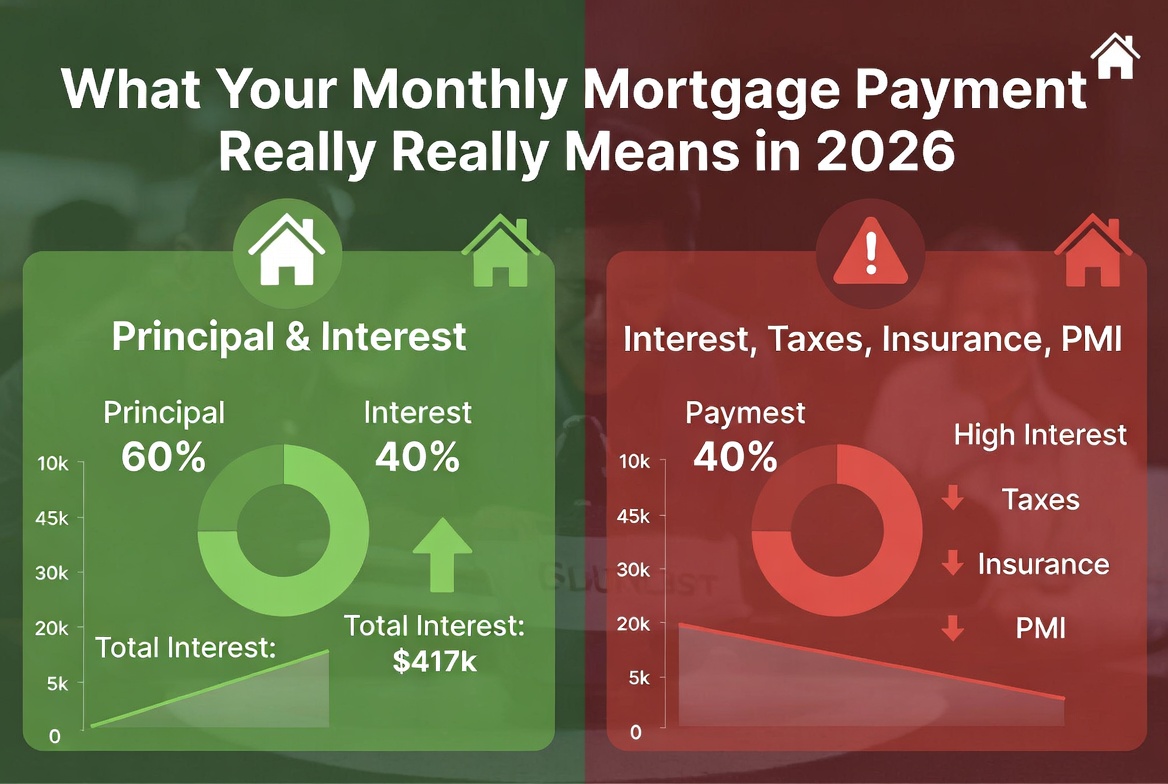
Your total house payment is usually called PITI:
- Principal — the actual amount borrowed
- Interest — the cost of borrowing the money
- Taxes — property taxes (usually escrowed)
- Insurance — homeowners insurance + possibly mortgage insurance (PMI)
Our Mortgage Calculator focuses on the principal + interest portion (the part you can control), but we’ll show you how to factor in taxes and insurance for the full picture.
The Mortgage Payment Formula Explained
The standard formula used by every mortgage calculator (including ours) is:
M=P(1+r)n−1r(1+r)n
Where:
- M = monthly principal + interest payment
- P = loan principal (home price minus down payment)
- r = monthly interest rate (annual rate ÷ 12)
- n = total number of payments (loan years × 12)

2026 Example: $320,000 loan (80% of a $400,000 home) at 6.6% interest for 30 years. Monthly principal + interest = ≈ $2,048
That’s $2,048 every month for 360 months = $737,280 total paid — of which $417,280 is pure interest.
Try It Yourself – Free Mortgage Calculator (Updated for 2026 Rates)
Ready to see your own numbers?
(Embed your Mortgage Calculator tool here – https://keytext.net/finance/mortgage-calculator/)
How to use it in seconds:
- Enter the home price
- Enter your down payment (or down payment %)
- Choose a loan term (15-year vs 30-year makes a huge difference)
- Enter current interest rate (use 6.6% as a realistic 2026 starting point)
- Add estimated property taxes and insurance if you want the full PITI payment
- Hit Calculate
Pro tip: Try changing the interest rate by just 0.5% and watch how much the monthly payment and total interest change.
3 Real 2026 Scenarios That Show What Your Payment Really Means
1. First-Time Buyer (Entry-Level Home)
- Home price: $380,000
- Down payment: 5% ($19,000)
- Loan amount: $361,000
- Rate: 6.6% (30-year fixed)
- Monthly P+I: ≈ $2,307
- Total interest over 30 years: ≈ $469,500
Add $400/month for taxes + insurance, and your real payment is ≈ $2,707.
2. Move-Up Buyer (Family Home)
- Home price: $650,000
- Down payment: 20% ($130,000)
- Loan amount: $520,000
- Rate: 6.6%
- Monthly P+I: ≈ $3,323
- With a 15-year loan instead: Monthly jumps to ≈ $4,570, but you save $280,000+ in interest and own the home 15 years sooner.
3. Refinancing in 2026
You bought in 2024 at 7.2%. Rates have dropped to 6.6%.
- Refinancing a $400,000 remaining balance could drop your payment by $180–$220/month and save $65,000 in total interest.
(Try your own refinance scenario with our Mortgage Calculator)
7 Smart Ways to Lower Your Mortgage Payment or Total Cost in 2026
- Put down at least 20% to avoid PMI (adds ~0.5–1% to your effective rate).
- Shop rates aggressively — even 0.25% lower saves thousands.
- Choose a 15-year loan if you can afford the higher payment (huge interest savings).
- Pay extra toward principal every month (even $100–$200 makes a massive difference).
- Buy mortgage points if you plan to stay 7+ years.
- Improve your credit score before applying (can drop your rate 0.25–0.75%).
- Refinance when rates drop — our calculator makes it easy to compare.
4 Mistakes That Make Your Mortgage More Expensive
- Focusing only on the monthly payment instead of the total interest
- Skipping the rate-shopping step
- Taking a longer loan term just to lower the monthly number
- Not accounting for taxes, insurance, and maintenance (the real “payment”)
Frequently Asked Questions About Mortgage Payments in 2026
What’s the difference between 15-year and 30-year loans? 15-year loans have much higher monthly payments but save a fortune in interest and build equity faster.
Should I pay points or take the higher rate? If you plan to stay in the home 7+ years, paying points usually saves money.
How much do taxes and insurance add? On average, expect $300–$600+ per month, depending on location and home value.
Can I use the calculator for refinancing? Yes! Just enter your current balance as the “loan amount” and compare scenarios.
How accurate are online mortgage calculators? Extremely accurate for principal + interest. They don’t include lender-specific fees, which is why you should always get official quotes.
Ready to Run Your Numbers?
Your monthly mortgage payment isn’t just a number — it’s one of the biggest financial decisions you’ll ever make. Understanding exactly what it means and how to optimize it can save you tens (or hundreds) of thousands of dollars over the life of the loan.
See exactly what your payment will be in 2026:
(Embed Mortgage Calculator again here)
Or go back and read our previous guide: How Compound Interest Really Works in 2026 — because every extra dollar you pay toward principal is money that stops working against you.
Written by the KeyText Team. We build free, accurate online tools so you can make smarter financial decisions — no sign-up, no spam, just results.